Enzyme Testing Supplier for Testing: Enzyme Sample & Testing Service for Formulations
Source enzyme samples for R&D, lab screening, and pilot validation with COA/TDS/SDS, dosage guidance, QC checks, and cost-in-use support.
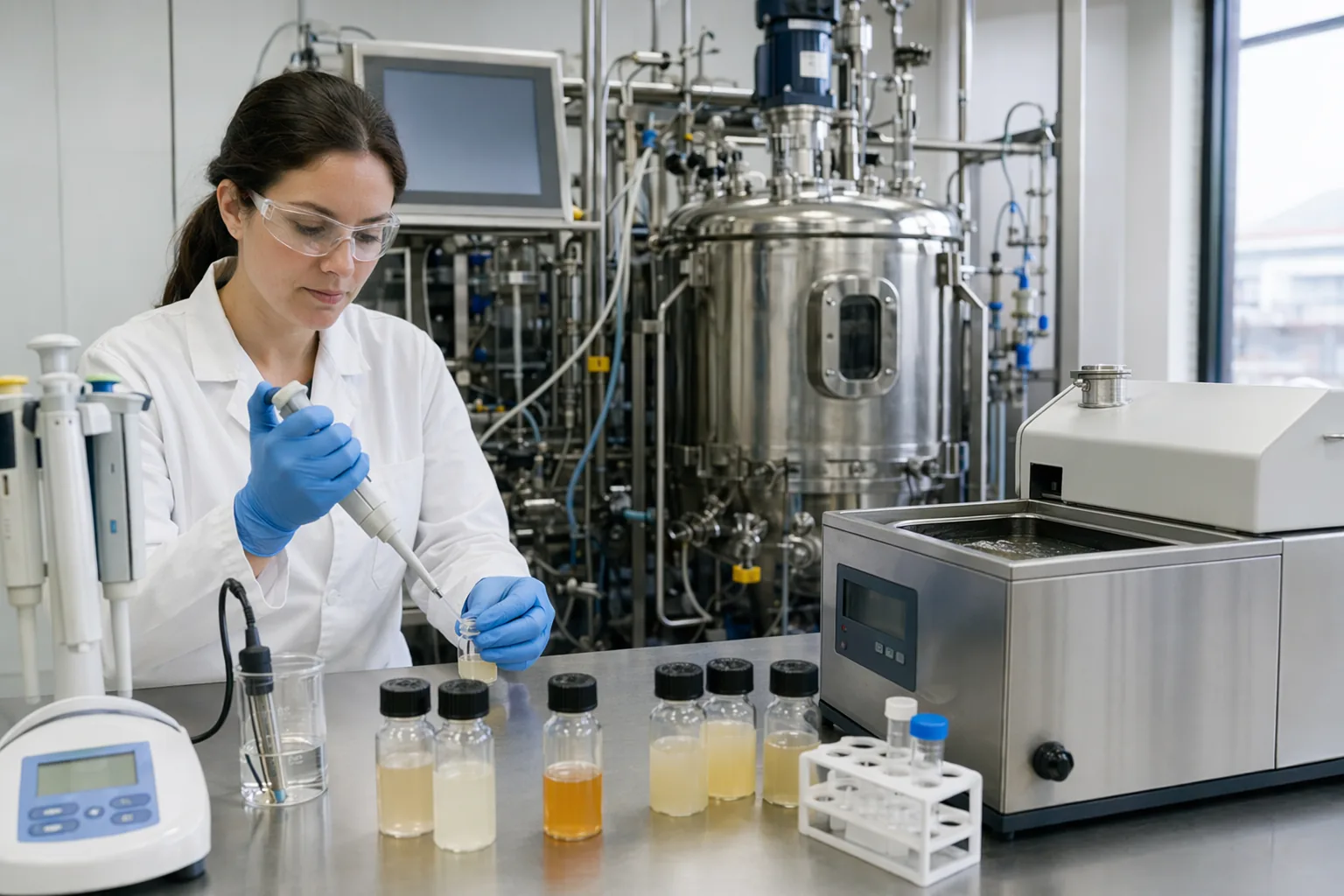
EnzymeCollect helps industrial buyers source small-quantity enzyme samples, compare activity under real process conditions, and move from bench testing to pilot validation with better purchasing confidence.
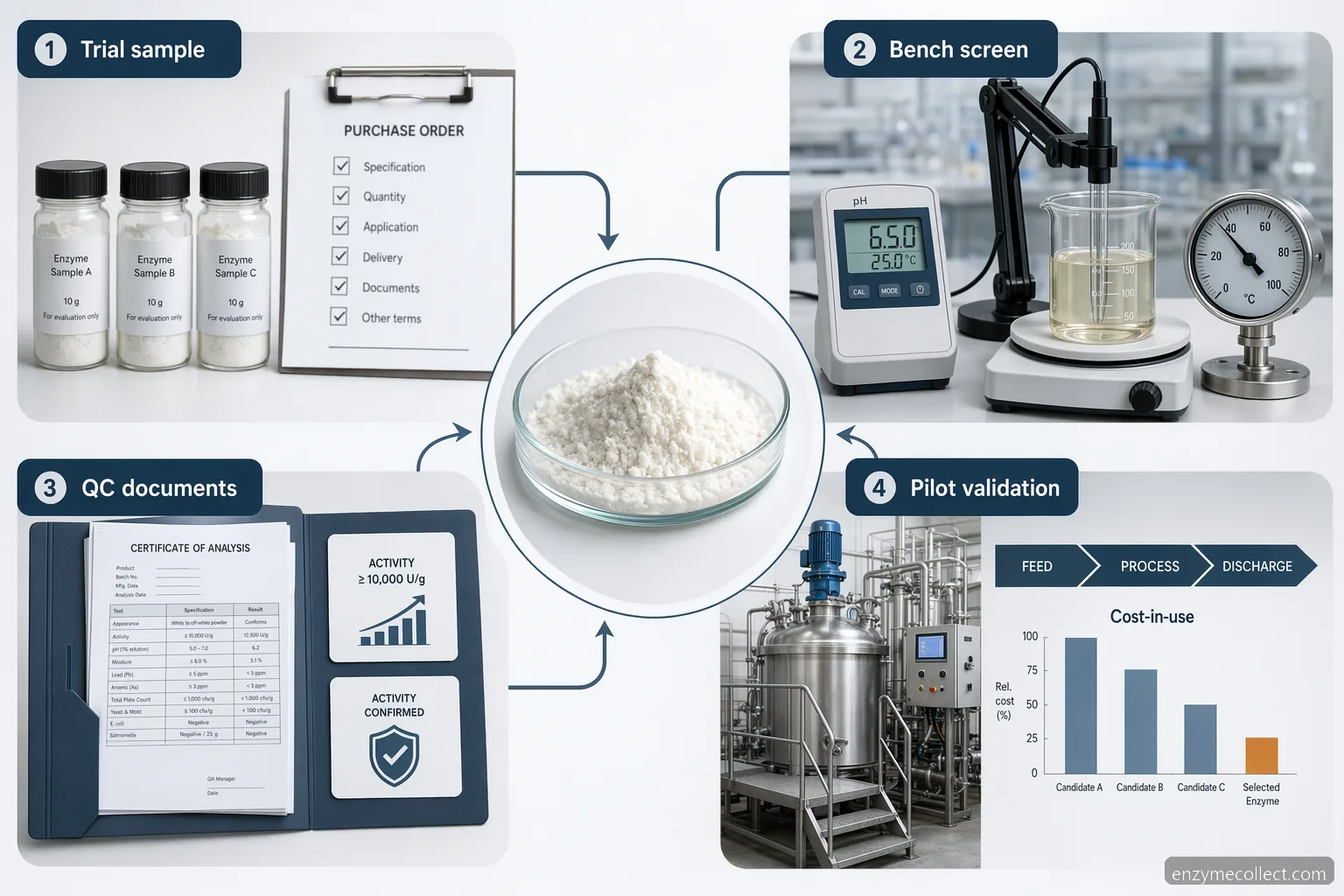
Why Work With an Enzyme Testing Supplier for Testing
An enzyme testing supplier for testing supports formulation teams that need evidence before committing to production-scale purchasing. Instead of ordering full drums or totes too early, buyers can request enzyme samples for controlled screening in R&D, application labs, or pilot scale. This approach is useful when comparing proteases, amylases, cellulases, lipases, pectinases, xylanases, lactases, and other industrial enzymes for food processing, detergents, textiles, pulp and paper, feed, starch conversion, brewing, or bioprocessing. The goal is not simply to receive a vial; it is to receive a usable technical package. A qualified enzyme samples supplier for testing should provide concentration or activity information, recommended handling, storage temperature, shelf-life guidance, and safety documentation. EnzymeCollect is positioned for buyers who need small quantity enzymes, structured trial orders, and practical testing support before negotiating commercial supply.
Ideal for R&D formulation screening • Supports pilot-scale process confirmation • Reduces risk before bulk purchase • Aligns technical and procurement teams
How to Define Your Enzyme Trial Order
A clear trial order begins with the substrate, target function, and operating window. For example, a starch process may require alpha-amylase testing at pH 5.5-6.5 and 80-95°C, while a detergent protease screen may need pH 8.0-10.5 and 30-60°C. Pectinase or cellulase trials may be evaluated at pH 3.5-5.5 and 35-55°C, depending on the application. As an enzyme trial order supplier for testing, the supplier should help define sample size, dose ladder, dilution method, and acceptance criteria. Common starting dosage bands range from 0.01-0.5% w/w in formulated products or 50-1,000 ppm active preparation in process trials, but the correct range depends on enzyme activity, substrate load, contact time, and process economics.
State substrate type and solids level • Define pH, temperature, and contact time • Request low, medium, and high dosage points • Confirm storage and dilution instructions
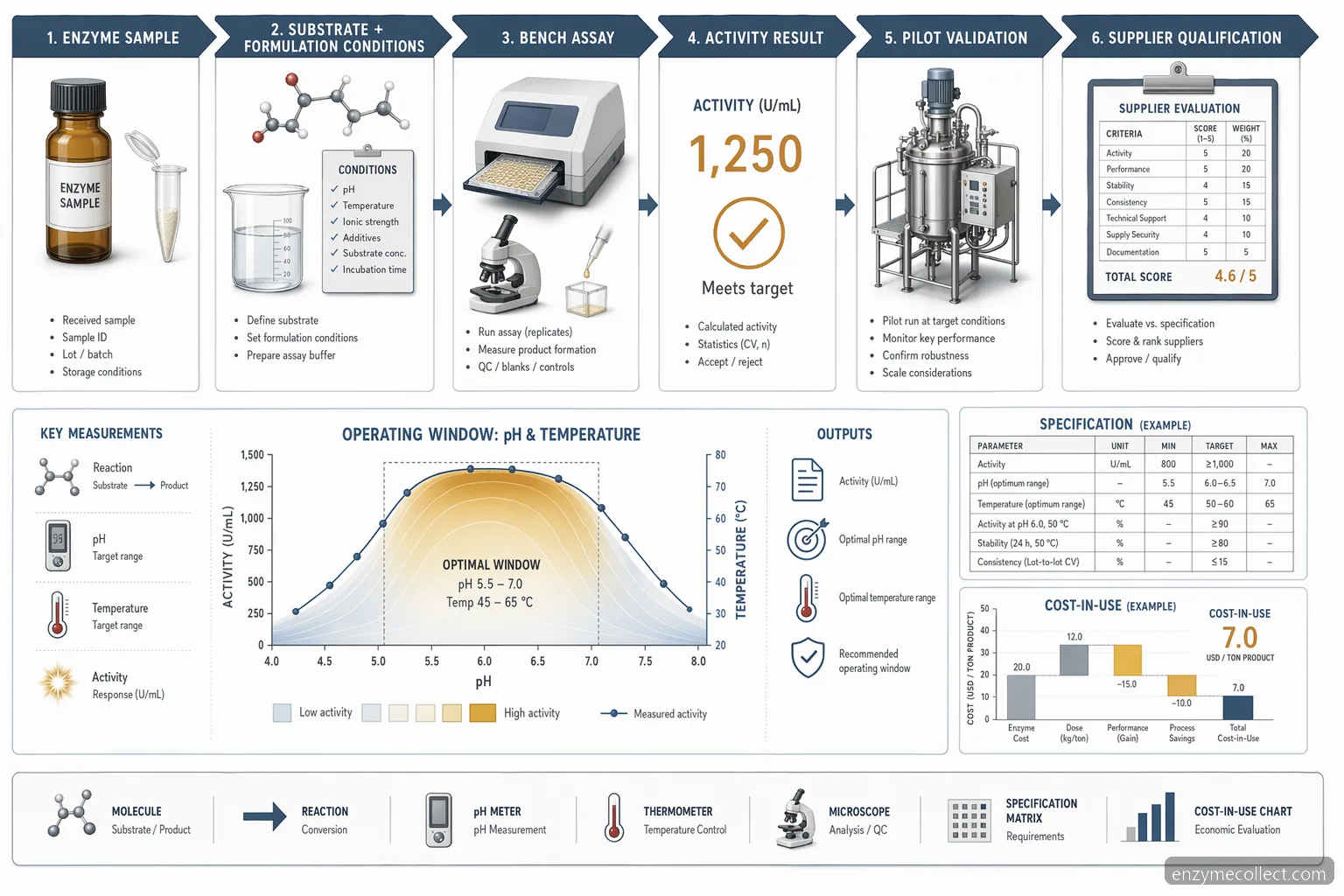
Documentation Buyers Should Request
Industrial enzyme testing depends on reliable documentation. Before lab work begins, request a certificate of analysis (COA), technical data sheet (TDS), safety data sheet (SDS), allergen or composition statement where relevant, and the activity assay method used by the producer. The COA should identify batch number, appearance, activity value, and basic release checks. The TDS should explain application range, pH and temperature stability, recommended dosage, storage, and compatibility warnings. The SDS supports safe handling, PPE selection, spill response, and transport review. For regulated or customer-sensitive applications, ask whether additional statements are available, but avoid assuming certifications that are not documented. A capable enzyme testing supplier for R&D will also clarify whether the sample is liquid, powder, granulate, or immobilized form and whether preservatives, carriers, salts, or stabilizers may affect the formulation.
COA for batch and activity confirmation • TDS for application and dosage guidance • SDS for safe handling review • Assay method for comparable activity data
Bench Screening and QC Checks
Bench testing should be designed to show both enzyme performance and formulation compatibility. Use a control with no enzyme, at least three dosage levels, and duplicate or triplicate runs when sample volume allows. Track pH drift, temperature profile, mixing time, viscosity, turbidity, soluble solids, reducing sugars, degree of hydrolysis, stain removal, fiber modification, or other application-specific markers. For many enzymes, activity may decline outside the recommended pH and temperature range, so include stability holds such as 30, 60, and 120 minutes when process residence time is important. QC checks should include appearance, odor, sediment, microbial limits where required, and activity retention after storage. This is the core of industrial enzyme testing R&D: translating a supplier sample into measurable process data rather than relying only on label activity.
Run controls and dose-response curves • Measure performance and side effects • Check activity retention after storage • Record all dilution and handling steps
From Lab Result to Pilot Validation
Positive bench data should be confirmed at pilot scale before commercial commitment. Mixing energy, heat transfer, residence time, substrate variability, and downstream separation can change enzyme performance. An enzyme testing supplier for pilot scale should help convert lab dosage into pilot conditions, such as units per kilogram substrate, ppm preparation, or percentage by formulation weight. Pilot validation should confirm yield improvement, reaction endpoint, cleaning performance, filtration rate, viscosity reduction, texture, color, or by-product profile. It should also test process robustness at the practical edges of pH, temperature, and hold time. Industrial enzyme trial order testing is most valuable when procurement, production, QA, and R&D agree on pass/fail criteria before the run. This makes supplier qualification faster and avoids overvaluing a sample that performs only under ideal bench conditions.
Confirm scale-up dosage basis • Test realistic process variability • Document pass/fail criteria • Capture data for supplier qualification
Cost-in-Use and Supplier Qualification
The lowest sample price is rarely the best purchasing metric. Cost-in-use compares enzyme activity, dosage, yield effect, process time, waste reduction, handling cost, freight, shelf life, and batch consistency. Two enzymes with the same nominal activity can perform differently if the assay method, formulation stabilizers, or application conditions differ. During supplier qualification, evaluate response speed, documentation completeness, technical support, sample traceability, lead time, packaging options, and ability to support repeated trial orders. Buyers searching for an enzyme testing supplier for testing should also ask whether commercial lots can be matched to pilot samples and whether retain samples or batch trend data are available. A structured evaluation helps separate promising enzymes from unsuitable options before purchase orders become large and operational risk increases.
Compare cost per treated unit, not only price per kilogram • Check batch-to-batch consistency • Review lead time and packaging flexibility • Confirm commercial supply alignment
Technical Buying Checklist
Buyer Questions
An enzyme trial order supplier for testing provides small-quantity enzymes and technical documents for controlled lab or pilot evaluation. The objective is to compare performance before commercial buying. A useful trial order should include COA, TDS, SDS, activity method, recommended storage, and starting dosage guidance so your R&D team can run structured, repeatable formulation tests.
An enzyme testing supplier for R&D focuses on sample selection, application fit, documentation, and screening support before bulk procurement. A bulk distributor may be optimized for volume supply, while R&D testing requires smaller quantities, clearer technical guidance, batch traceability, and help defining pH, temperature, dosage, and QC checks for early-stage formulation work.
Yes. Pilot work should translate bench results into realistic production-like conditions. That means confirming dosage basis, mixing, contact time, temperature control, substrate variability, downstream effects, and cost-in-use. An enzyme testing supplier for pilot scale should help align the pilot lot with commercial supply expectations and provide documentation for supplier qualification.
No. The phrase react unit testing with jest enzyme sample refers to software testing terminology, not industrial enzyme samples. EnzymeCollect supports wet-lab and process testing for industrial enzyme formulations, including R&D trials, application screening, pilot validation, COA/TDS/SDS review, and supplier qualification for manufacturing buyers.
Some buyers use duplicate wording such as industrial enzyme testing testing when they mean enzyme samples for application testing. In practice, the project should define the enzyme class, substrate, process conditions, QC method, and success criteria. Clear terminology helps suppliers recommend the correct trial order and avoids receiving a sample that does not match the intended formulation.
Industrial enzyme testing R&D teams should compare samples using the same substrate, pH, temperature, contact time, and dose-response design. Include a no-enzyme control and repeat key conditions. Review activity method, formulation type, stability, side effects, and cost-in-use. The best sample is the one that performs consistently under your process conditions, not just the one with the highest label activity.
Alpha-Galactosidase for Research & Industry
Need Alpha-Galactosidase for your lab or production process?
ISO 9001 certified · Food-grade & research-grade · Ships to 80+ countries
Frequently Asked Questions
What is an enzyme trial order supplier for testing?
An enzyme trial order supplier for testing provides small-quantity enzymes and technical documents for controlled lab or pilot evaluation. The objective is to compare performance before commercial buying. A useful trial order should include COA, TDS, SDS, activity method, recommended storage, and starting dosage guidance so your R&D team can run structured, repeatable formulation tests.
How is an enzyme testing supplier for R&D different from a bulk distributor?
An enzyme testing supplier for R&D focuses on sample selection, application fit, documentation, and screening support before bulk procurement. A bulk distributor may be optimized for volume supply, while R&D testing requires smaller quantities, clearer technical guidance, batch traceability, and help defining pH, temperature, dosage, and QC checks for early-stage formulation work.
Can you support enzyme testing supplier for pilot scale projects?
Yes. Pilot work should translate bench results into realistic production-like conditions. That means confirming dosage basis, mixing, contact time, temperature control, substrate variability, downstream effects, and cost-in-use. An enzyme testing supplier for pilot scale should help align the pilot lot with commercial supply expectations and provide documentation for supplier qualification.
Is this related to react unit testing with jest enzyme sample?
No. The phrase react unit testing with jest enzyme sample refers to software testing terminology, not industrial enzyme samples. EnzymeCollect supports wet-lab and process testing for industrial enzyme formulations, including R&D trials, application screening, pilot validation, COA/TDS/SDS review, and supplier qualification for manufacturing buyers.
What does industrial enzyme testing testing mean in procurement notes?
Some buyers use duplicate wording such as industrial enzyme testing testing when they mean enzyme samples for application testing. In practice, the project should define the enzyme class, substrate, process conditions, QC method, and success criteria. Clear terminology helps suppliers recommend the correct trial order and avoids receiving a sample that does not match the intended formulation.
How should industrial enzyme testing R&D teams compare samples?
Industrial enzyme testing R&D teams should compare samples using the same substrate, pH, temperature, contact time, and dose-response design. Include a no-enzyme control and repeat key conditions. Review activity method, formulation type, stability, side effects, and cost-in-use. The best sample is the one that performs consistently under your process conditions, not just the one with the highest label activity.
Ready to source?
Turn This Guide Into a Supplier Brief Request enzyme samples, COA/TDS/SDS, and trial guidance for your next R&D or pilot-scale formulation test.
Contact Us to Contribute