Enzyme Testing Supplier for R&D: Sample & Trial Order Checklist
Compare enzyme samples, trial quantities, QC documents, pilot validation, and cost-in-use before choosing an R&D testing supplier.
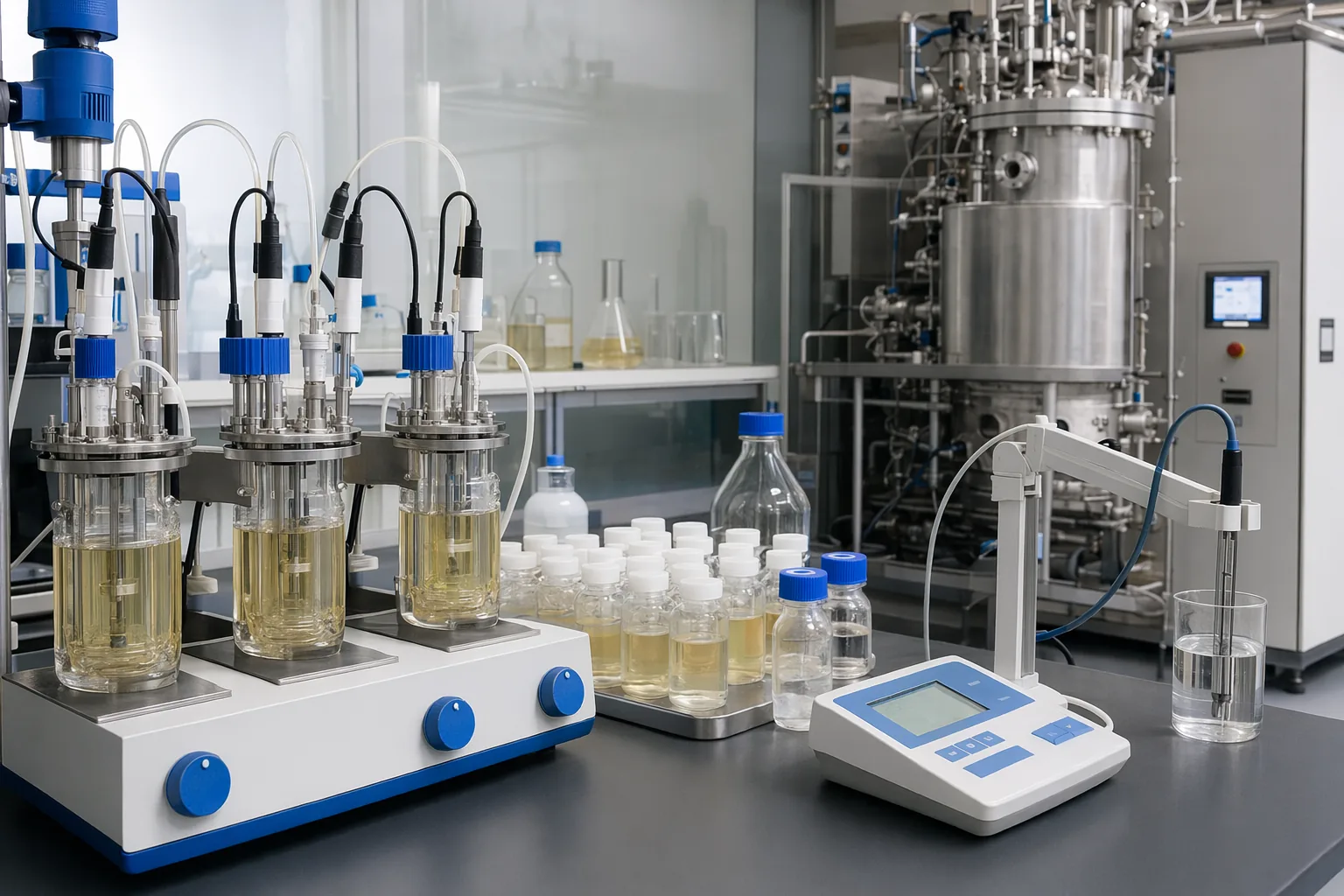
Use this B2B checklist to compare enzyme samples, small trial orders, documentation, and pilot-scale support before committing to bulk supply.
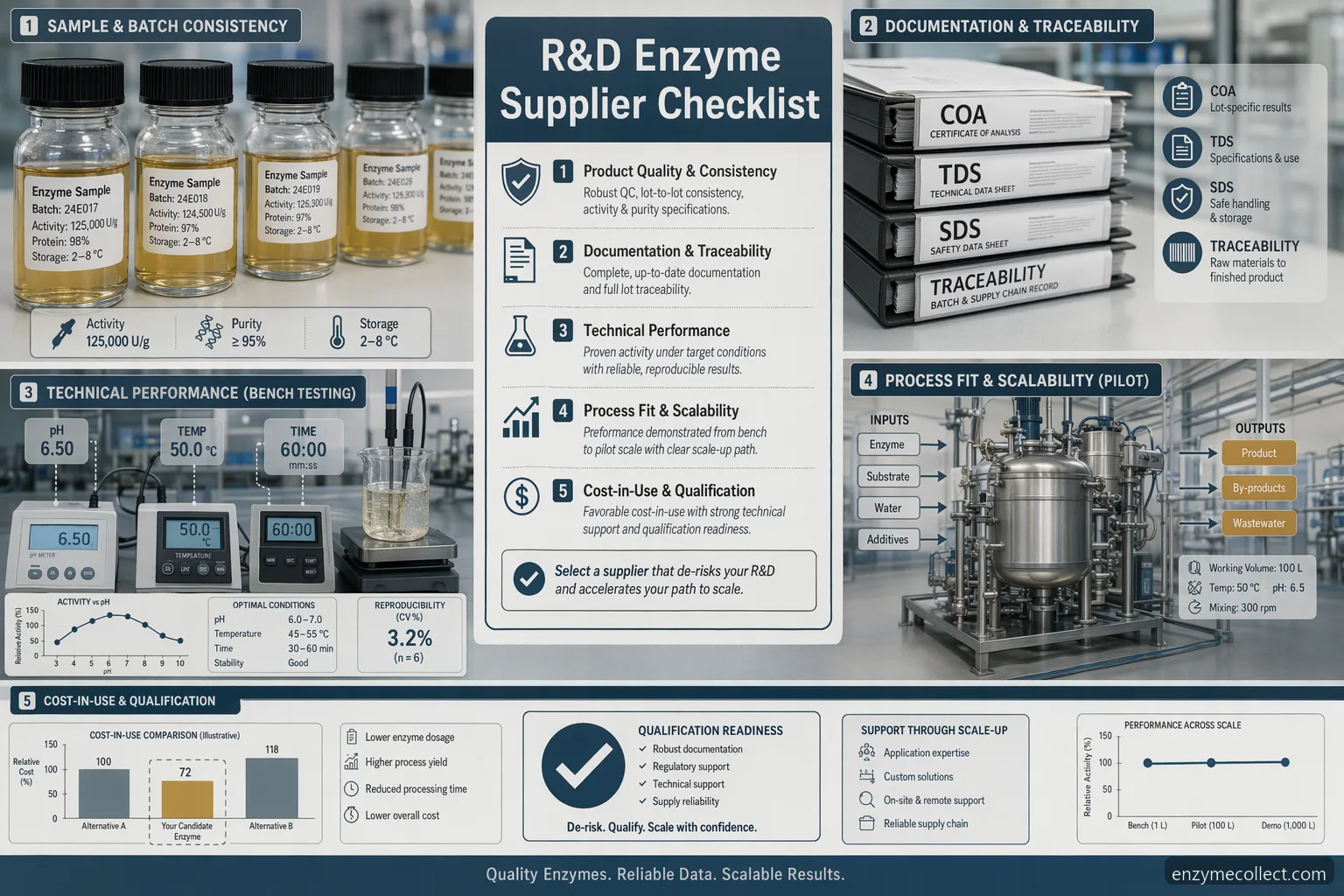
How to Compare an Enzyme Testing Supplier for R&D
An enzyme testing supplier for R&D should help technical buyers reduce screening risk before purchasing production volumes. The comparison should start with application fit: substrate, target conversion, process pH, operating temperature, contact time, downstream limits, and compatibility with salts, surfactants, solvents, or preservatives. For most industrial trials, a practical supplier can provide enzyme samples or an enzyme trial order in small quantities, plus enough documentation to support safe handling and repeatable testing. Ask whether the supplier can recommend starting dosage bands, but require your own validation under plant-relevant conditions. A useful screening plan normally includes a blank control, a benchmark lot if available, a low-middle-high dosage range, and an agreed activity or performance assay. The goal is not to find the cheapest sample; it is to identify a dependable enzyme testing supplier for testing, pilot scale, and eventual purchasing review.
Define the application before requesting samples. • Compare activity method, not only activity number. • Request enough material for repeats and controls. • Document storage and handling from day one.
Sample Documentation: COA, TDS, SDS, and Traceability
For industrial enzyme testing R&D, documentation quality is part of the product specification. A certificate of analysis should identify the lot, activity value, test method, manufacture or release date, and any key physical or microbiological checks relevant to the material. The technical data sheet should state enzyme class, recommended pH and temperature ranges, appearance, carrier or formulation type, storage conditions, and typical use level. The safety data sheet should be current and appropriate for the supplied form, whether liquid, granule, powder, or concentrate. Buyers should also confirm allergen or sensitizer handling statements where applicable, because enzyme dusts and aerosols require workplace controls. If you need an enzyme samples supplier for testing, ask whether the same grade can be supplied later for pilot validation and commercial discussions, avoiding a sample that cannot be scaled or repeated.
COA: lot, activity, method, release data, QC checks. • TDS: enzyme class, use range, formulation, storage. • SDS: safe handling, exposure controls, transport details. • Traceability: sample lot linked to future supply lot.
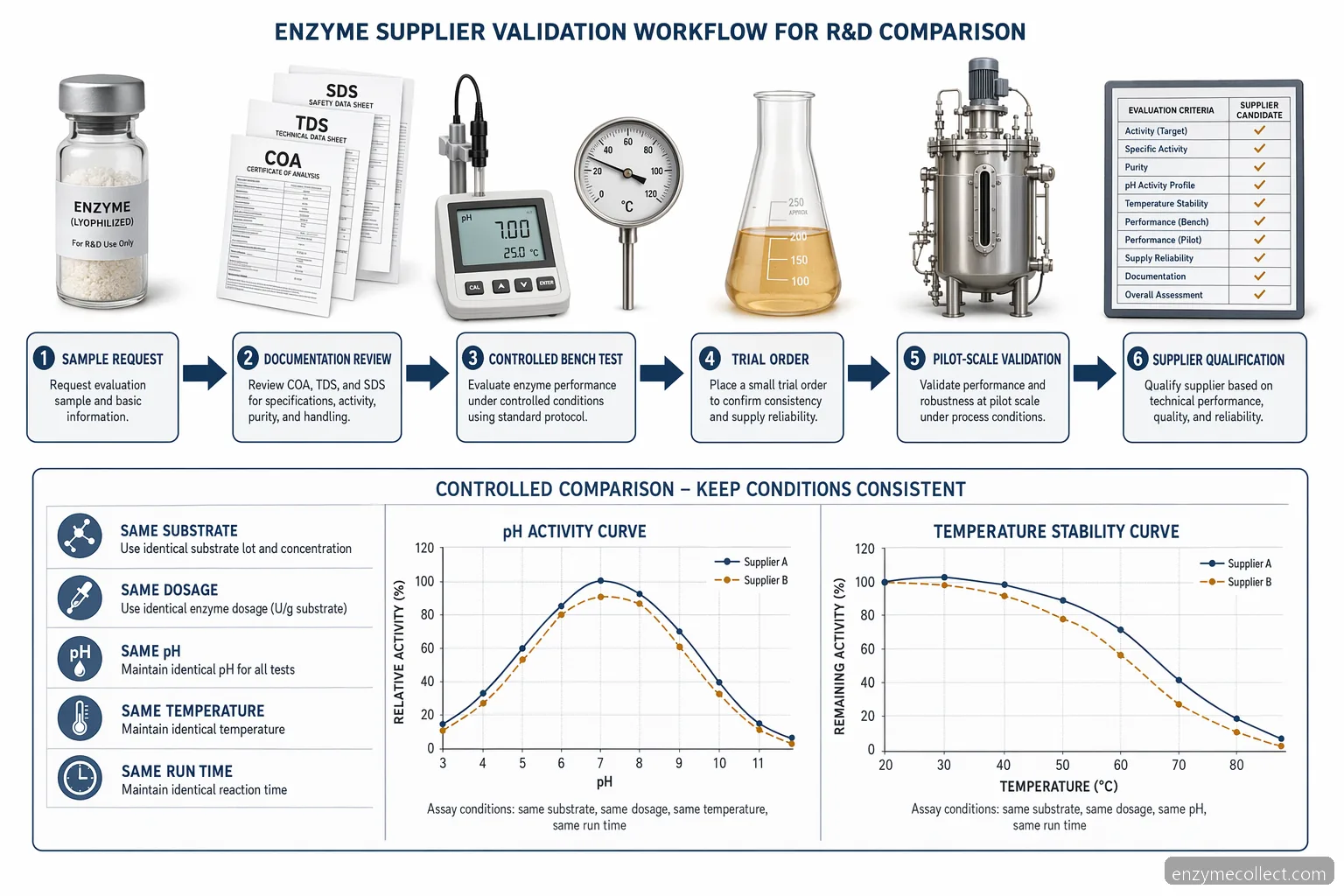
Bench Test Conditions That Make Supplier Comparisons Fair
A fair bench comparison uses the same substrate, water quality, pH, temperature, mixing, residence time, and analytical method for every candidate. Many industrial enzymes operate in broad but finite ranges, so begin with the supplier TDS and then test around your process setpoint. For example, many carbohydrase, protease, lipase, and cellulase trials may screen across pH 4.0 to 9.0 and 30°C to 65°C, but the valid range depends on enzyme type and formulation. Dosage is often screened as activity units per gram of substrate, ppm of product, or 0.01% to 1.0% on process mass, depending on application. Include a heat-inactivated control if useful, and measure both performance and side effects such as viscosity shift, odor, foam, color change, filtration rate, or downstream interference.
Hold pH within the tolerance of the real process. • Record exact temperature and reaction time. • Run low, medium, and high dosage points. • Measure conversion plus operational side effects.
From Enzyme Trial Order to Pilot-Scale Validation
An enzyme trial order supplier for testing should support the transition from small quantity enzymes to pilot-scale validation. Bench results rarely capture every factor found in tanks, reactors, mixers, spray systems, or continuous lines. Before scaling, define acceptance criteria such as percent conversion, viscosity reduction, yield improvement, cleaning performance, filtration gain, or processing time reduction. Pilot work should test the intended addition point, mixing energy, hold time, process interruptions, and inactivation or downstream removal method if required. For an enzyme testing supplier for pilot scale, ask about packaging sizes, lead times, minimum order quantities, lot reservation, storage stability, and whether a retained sample can be kept for comparison. Also confirm whether formulation changes, carrier changes, or concentration adjustments require advance notification, because these can affect performance even when activity appears similar.
Reserve enough lot material for repeat pilot runs. • Set pass/fail criteria before the trial. • Confirm lead time and trial packaging size. • Track any change in formulation or concentration.
Cost-in-Use and Supplier Qualification
Industrial enzyme trial order testing should end with a cost-in-use model, not a simple price comparison. Calculate the cost per batch, per ton of substrate, per unit of conversion, or per hour of process time saved. Include required dosage, dilution losses, storage losses, labor, process temperature changes, cleaning steps, waste impact, and downstream yield. A lower-priced product can be more expensive if it needs higher dosage, tighter temperature control, or longer residence time. Supplier qualification should review responsiveness, technical competence, documentation completeness, complaint handling, change notification, packaging suitability, and ability to support repeat lots. If a search term such as react unit testing with jest enzyme sample led you here, note that this page is about industrial enzyme samples and testing, not software test tools. The right supplier helps procurement, R&D, and operations make a documented, reproducible decision.
Compare cost per outcome, not only unit price. • Include handling, storage, and process impacts. • Review supplier communication and change control. • Keep all test records tied to lot numbers.
Technical Buying Checklist
Buyer Questions
Request a sample or trial order sized for repeat testing, plus COA, TDS, SDS, lot number, activity method, shelf-life guidance, and storage conditions. Provide the supplier with your substrate, pH, temperature, processing time, target result, and any restricted ingredients. This allows the supplier to recommend a starting dosage range while your team verifies performance under controlled bench conditions.
The required quantity depends on batch size, dosage range, number of repeats, and analytical method. For early screening, buyers often need enough material for blank controls, low-medium-high dosage points, duplicates, and a retained sample. If results may move quickly to pilot scale, ask whether the supplier can provide a larger trial order from the same or traceable lot.
Compare suppliers by activity method, application fit, documentation quality, responsiveness, lot traceability, sample availability, and pilot-scale support. Then calculate cost-in-use based on actual dosage, conversion, yield, process time, and downstream impact. A product with a higher unit price may be preferable if it works at lower dosage, reduces processing time, or improves consistency.
Control pH, temperature, substrate concentration, mixing, water quality, reaction time, enzyme dosage, and sampling method. Use the same analytical method for every supplier sample and include a blank control. When safe and relevant, screen near the real process setpoint rather than only at ideal lab conditions, because pilot performance depends on practical operating limits.
No. This page is for B2B industrial enzyme samples, enzyme testing, and trial orders used in R&D, testing, and pilot-scale applications. It is not medical supplement advice and it is not about software libraries. The focus is supplier comparison, technical documentation, process validation, cost-in-use, and qualification for industrial enzyme purchasing decisions.
Alpha-Galactosidase for Research & Industry
Need Alpha-Galactosidase for your lab or production process?
ISO 9001 certified · Food-grade & research-grade · Ships to 80+ countries
Frequently Asked Questions
What should I request from an enzyme testing supplier for R&D?
Request a sample or trial order sized for repeat testing, plus COA, TDS, SDS, lot number, activity method, shelf-life guidance, and storage conditions. Provide the supplier with your substrate, pH, temperature, processing time, target result, and any restricted ingredients. This allows the supplier to recommend a starting dosage range while your team verifies performance under controlled bench conditions.
How much enzyme sample is needed for industrial testing?
The required quantity depends on batch size, dosage range, number of repeats, and analytical method. For early screening, buyers often need enough material for blank controls, low-medium-high dosage points, duplicates, and a retained sample. If results may move quickly to pilot scale, ask whether the supplier can provide a larger trial order from the same or traceable lot.
How do I compare enzyme suppliers beyond price?
Compare suppliers by activity method, application fit, documentation quality, responsiveness, lot traceability, sample availability, and pilot-scale support. Then calculate cost-in-use based on actual dosage, conversion, yield, process time, and downstream impact. A product with a higher unit price may be preferable if it works at lower dosage, reduces processing time, or improves consistency.
What bench test conditions should be controlled?
Control pH, temperature, substrate concentration, mixing, water quality, reaction time, enzyme dosage, and sampling method. Use the same analytical method for every supplier sample and include a blank control. When safe and relevant, screen near the real process setpoint rather than only at ideal lab conditions, because pilot performance depends on practical operating limits.
Is this page about medical supplements or software testing?
No. This page is for B2B industrial enzyme samples, enzyme testing, and trial orders used in R&D, testing, and pilot-scale applications. It is not medical supplement advice and it is not about software libraries. The focus is supplier comparison, technical documentation, process validation, cost-in-use, and qualification for industrial enzyme purchasing decisions.
Ready to source?
Turn This Guide Into a Supplier Brief Request enzyme samples and trial-order support for your R&D testing plan.
Contact Us to Contribute