Industrial Enzyme Testing Testing for R&D and Pilot Trials
Order small-quantity industrial enzyme samples for dosage, pH, temperature, QC, COA/TDS/SDS review, and pilot validation.
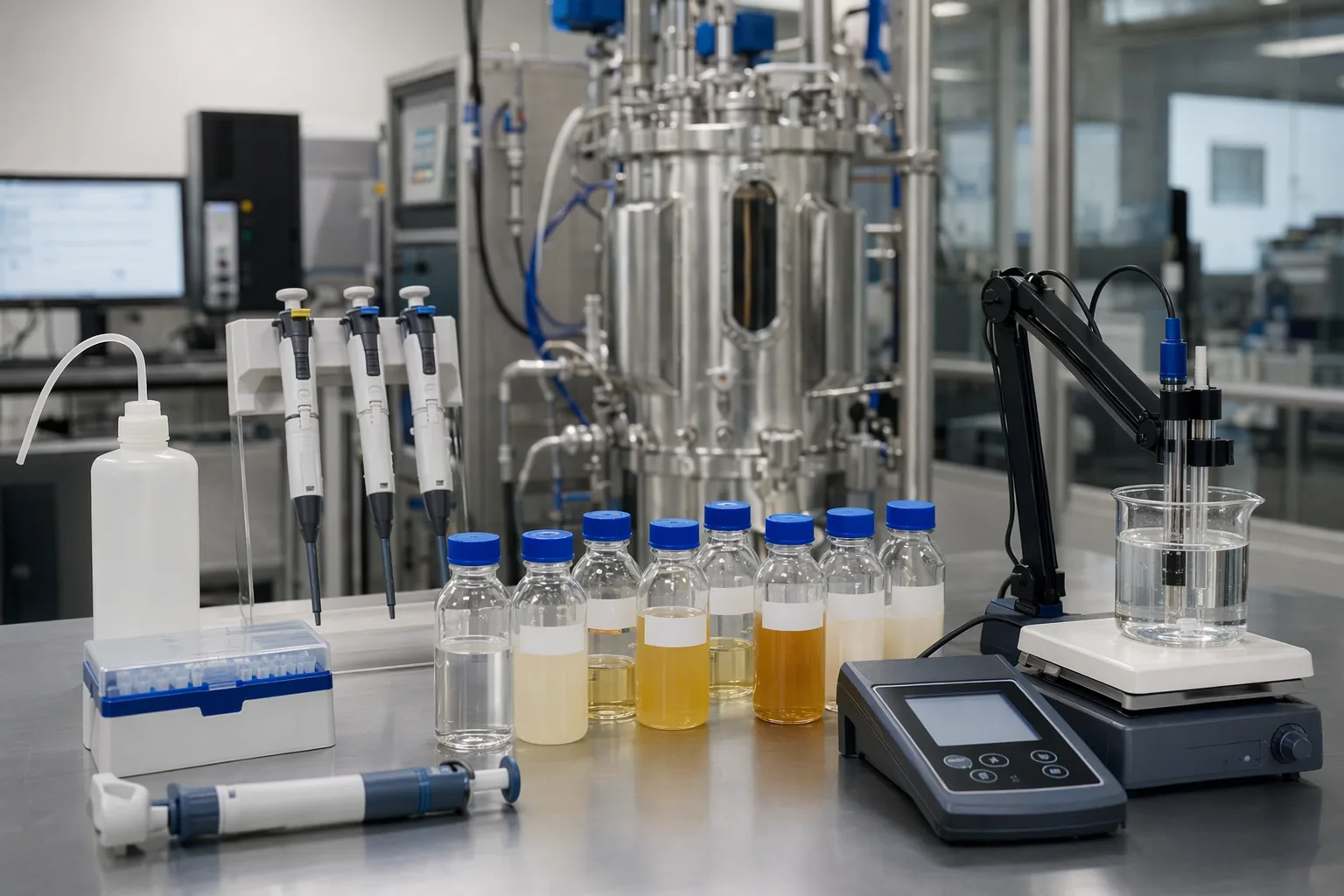
Troubleshoot process fit before committing to bulk supply with small-quantity enzyme samples, documented technical data, and practical testing guidance.
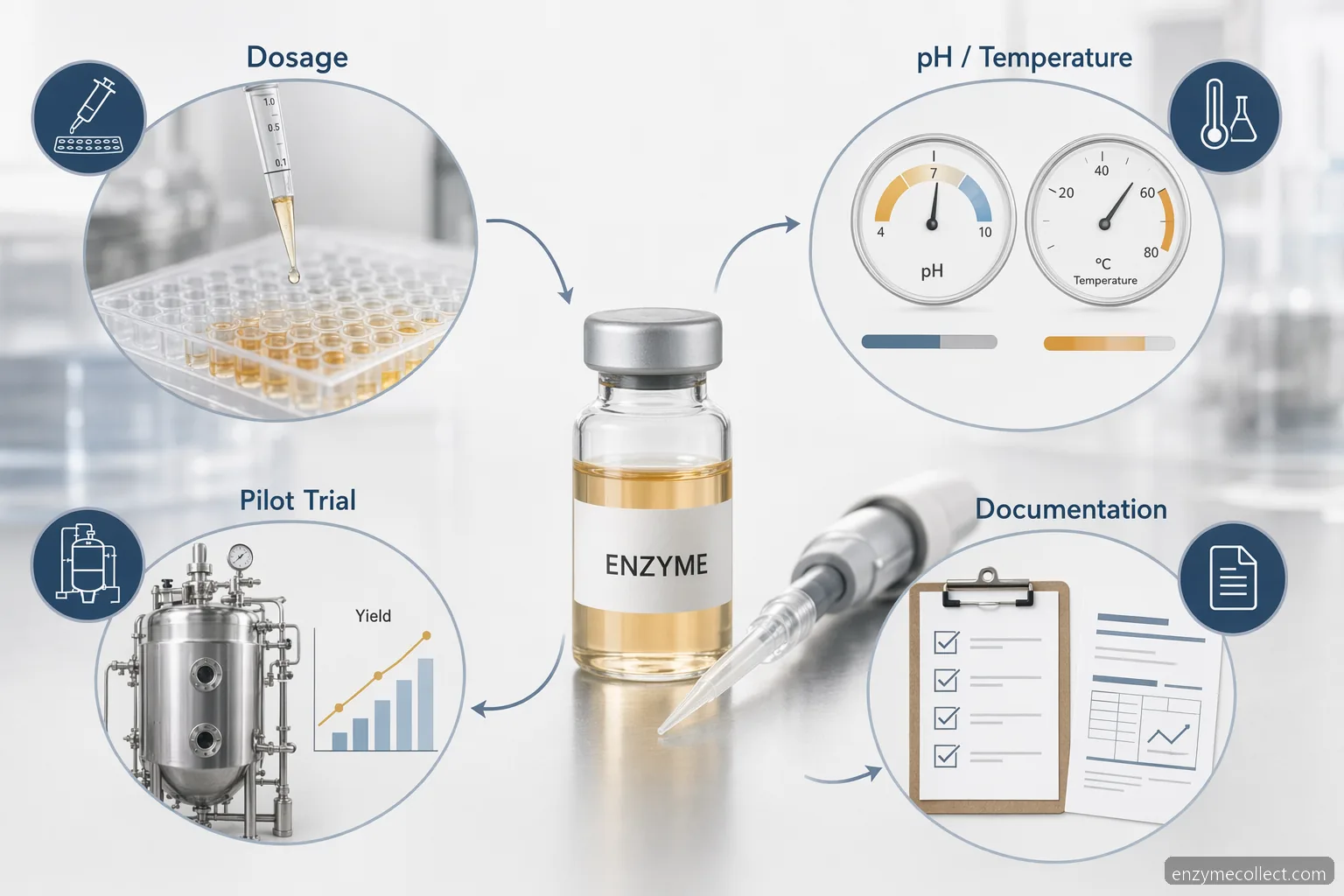
A Practical Route for Industrial Enzyme Samples Testing
Industrial enzyme testing testing should begin with a defined process question: improved conversion, lower viscosity, faster clarification, cleaner textile processing, reduced chemical load, or better yield stability. EnzymeCollect.com supports buyers looking for small quantity enzymes for screening before procurement teams approve larger volumes. A trial order is typically used to compare enzyme class, activity level, formulation type, and compatibility with the real substrate rather than relying only on literature values. For troubleshooting, record the baseline process, then test one variable at a time: dosage, pH, temperature, residence time, agitation, solids content, and any inhibitors. This creates a defensible data set for R&D, technical purchasing, and plant operations. Each enzyme sample should be tied to its COA, TDS, SDS, lot number, and recommended storage conditions so performance differences can be traced during supplier qualification.
Best fit for R&D screening, testing, and pilot scale checks • Use real substrate where possible, not only model solutions • Document lot number, activity units, and storage history
Set Dosage, pH, and Temperature Windows Before Scale-Up
For industrial enzyme testing R&D, start with a dosage ladder instead of a single addition rate. Depending on enzyme type and substrate concentration, initial lab bands may range from 0.01% to 1.0% w/w on substrate, or from 50 to 5,000 activity units per gram of substrate when activity units are specified. pH should be screened around the expected operating zone, such as pH 4.0 to 6.0 for many acid-active preparations, pH 6.0 to 8.0 for near-neutral systems, and pH 8.0 to 10.5 for alkaline processes where the enzyme is designed for that range. Temperature screening often runs from 30°C to 65°C, with thermostable candidates tested higher only when supported by the TDS. Measure performance at defined intervals so temperature gain is not confused with enzyme deactivation.
Run dosage ladders before choosing a target use rate • Check pH drift during the trial, not only at startup • Confirm that test temperatures match TDS guidance
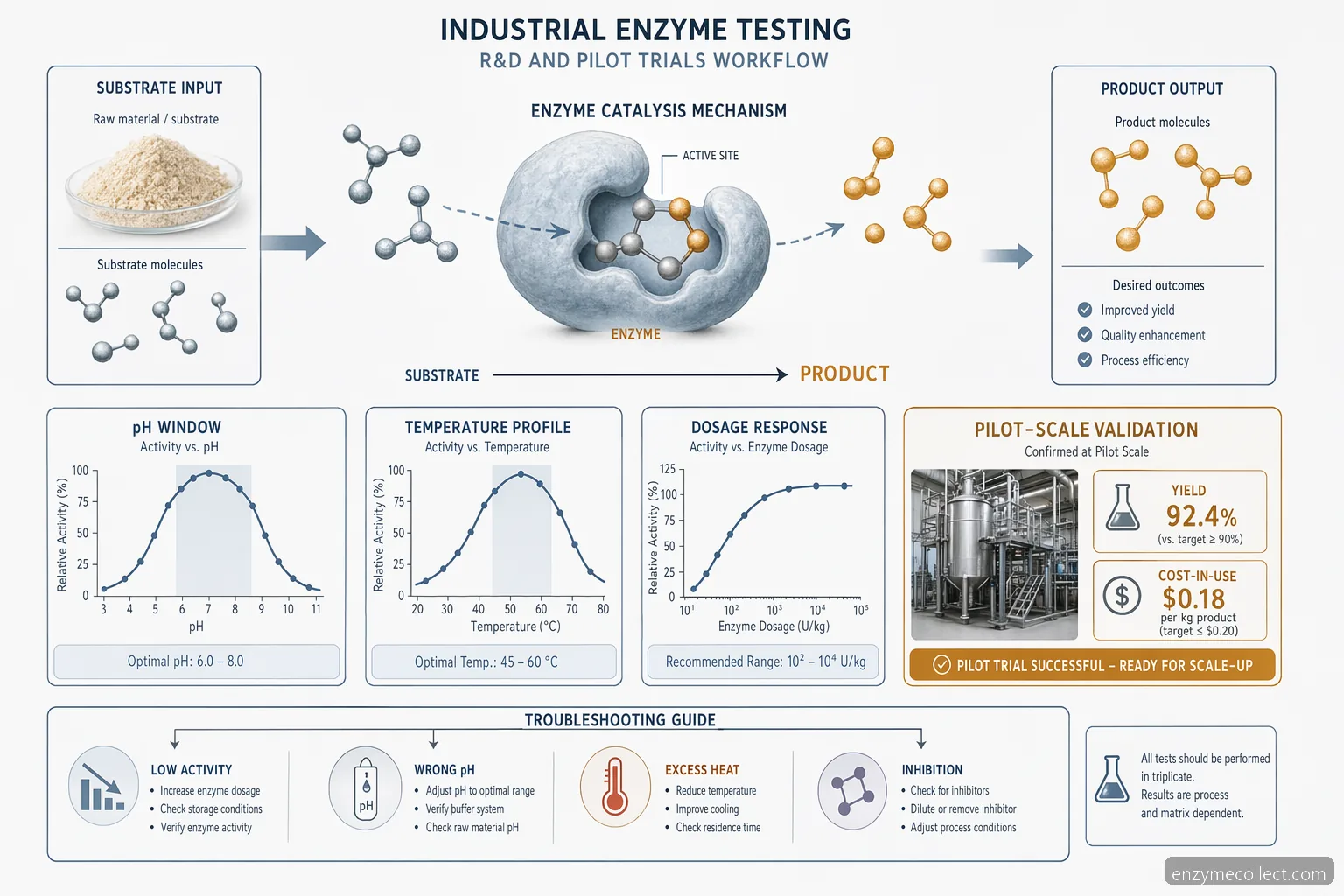
Troubleshooting Poor Enzyme Trial Results
A failed industrial enzyme trial order testing result does not always mean the enzyme is unsuitable. Low response can come from incorrect pH, excessive temperature, insufficient contact time, poor mixing, substrate variability, preservatives, oxidizers, surfactants, chelants, heavy metals, or residual cleaning chemicals. In solid or slurry systems, mass transfer can be as important as enzyme activity. If results are inconsistent, repeat the trial with a fresh sample, verified storage conditions, and a controlled blank. Include a heat-inactivated enzyme control when practical to separate enzymatic action from formulation effects. For industrial enzyme samples R&D, QC checks should include pH, temperature profile, substrate dry solids, viscosity or particle size where relevant, and final product quality metrics. These checks help technical teams identify whether the issue is chemistry, process control, or sample handling.
Use blanks and controls to isolate enzyme effect • Check for inhibitors such as oxidizers or residual cleaners • Repeat key trials with controlled sample storage
Pilot Scale Validation and Cost-in-Use
Industrial enzyme testing pilot scale work should confirm that bench performance survives real equipment conditions. Pilot validation may include mixing energy, heat-up time, dosing point, residence time distribution, shear exposure, and downstream separation. A typical pilot plan compares the current process against two or three enzyme dosage levels, then measures yield, throughput, quality, wastewater load, filtration rate, or cleaning performance depending on the application. Cost-in-use should be calculated from the enzyme dose, activity level, delivered price, process time saved, yield increase, rework reduction, or chemical substitution. The lowest purchase price is not always the lowest operating cost if a higher dosage is required. Pilot data also helps procurement define specifications for future industrial enzyme trial order pilot scale supply and larger commercial batches.
Validate dosing point, hold time, and mixing at pilot scale • Compare delivered cost against actual performance • Use pilot data to set procurement specifications
Documentation for Supplier Qualification
Supplier qualification for industrial enzyme testing should include both technical fit and documentation control. Request a COA for the sample lot, a TDS with activity definition and recommended operating conditions, and an SDS covering handling, storage, and disposal precautions. Buyers should confirm packaging size, minimum trial order quantity, lead time, shelf life, storage temperature, allergen or sensitization handling notes where applicable, and whether the formulation is liquid, powder, granule, or immobilized. For industrial enzyme trial order R&D projects, keep the sample identity linked to lab notebook entries and pilot reports. This avoids confusion when moving from evaluation to repeat order. EnzymeCollect.com is positioned for teams that need practical sample access and testing support before committing to larger procurement, toll processing, or multi-site qualification.
Request COA, TDS, and SDS before plant trials • Confirm shelf life and storage temperature • Link test results to lot number and sample quantity
Technical Buying Checklist
Buyer Questions
The right sample size depends on substrate volume, dosage range, and number of conditions tested. Many bench programs can start with grams to hundreds of grams for powders or tens to hundreds of milliliters for liquids. Pilot trials may require larger quantities. Plan enough material for blanks, duplicates, dosage ladders, and one repeat confirmation run using the same lot.
Request a certificate of analysis, technical data sheet, and safety data sheet before testing. The COA should identify the lot and key quality results. The TDS should define activity units, application guidance, pH and temperature range, dosage suggestions, and storage. The SDS supports safe handling, transport, spill response, disposal, and worker training requirements.
Use the supplier TDS as the starting point, then bracket the actual process conditions. A practical screen tests two or three pH values around the operating target and several temperatures that reflect startup, normal operation, and upper-limit exposure. Always monitor pH and temperature during the run because drift or heat-up time can change the apparent enzyme response.
Cost-in-use combines delivered enzyme price with the dose required to meet the process target. It should also include yield improvement, cycle time reduction, reduced rework, lower chemical usage, wastewater impact, or improved product quality where measurable. Compare candidates on performance at equivalent process outcomes, not only price per kilogram or activity unit.
No. This page is for industrial enzyme samples used in manufacturing, R&D, testing, and pilot scale validation. It is not about software testing libraries or React unit testing. If your need involves process enzymes, small quantity trial orders, COA/TDS/SDS review, and dosage optimization, this service is aligned with your industrial testing workflow.
Alpha-Galactosidase for Research & Industry
Need Alpha-Galactosidase for your lab or production process?
ISO 9001 certified · Food-grade & research-grade · Ships to 80+ countries
Frequently Asked Questions
How much enzyme sample is needed for industrial testing?
The right sample size depends on substrate volume, dosage range, and number of conditions tested. Many bench programs can start with grams to hundreds of grams for powders or tens to hundreds of milliliters for liquids. Pilot trials may require larger quantities. Plan enough material for blanks, duplicates, dosage ladders, and one repeat confirmation run using the same lot.
What documents should come with an industrial enzyme trial order?
Request a certificate of analysis, technical data sheet, and safety data sheet before testing. The COA should identify the lot and key quality results. The TDS should define activity units, application guidance, pH and temperature range, dosage suggestions, and storage. The SDS supports safe handling, transport, spill response, disposal, and worker training requirements.
How do we choose pH and temperature conditions for enzyme testing?
Use the supplier TDS as the starting point, then bracket the actual process conditions. A practical screen tests two or three pH values around the operating target and several temperatures that reflect startup, normal operation, and upper-limit exposure. Always monitor pH and temperature during the run because drift or heat-up time can change the apparent enzyme response.
How should cost-in-use be calculated for an enzyme sample?
Cost-in-use combines delivered enzyme price with the dose required to meet the process target. It should also include yield improvement, cycle time reduction, reduced rework, lower chemical usage, wastewater impact, or improved product quality where measurable. Compare candidates on performance at equivalent process outcomes, not only price per kilogram or activity unit.
Is this related to react unit testing with jest enzyme sample searches?
No. This page is for industrial enzyme samples used in manufacturing, R&D, testing, and pilot scale validation. It is not about software testing libraries or React unit testing. If your need involves process enzymes, small quantity trial orders, COA/TDS/SDS review, and dosage optimization, this service is aligned with your industrial testing workflow.
Ready to source?
Turn This Guide Into a Supplier Brief Request an industrial enzyme sample for R&D, testing, or pilot-scale validation.
Contact Us to Contribute