Industrial Enzyme Samples Testing: Specification Checklist for Buyers
Compare industrial enzyme samples for testing with a practical checklist for R&D trials, pilot validation, QC review, and cost-in-use.
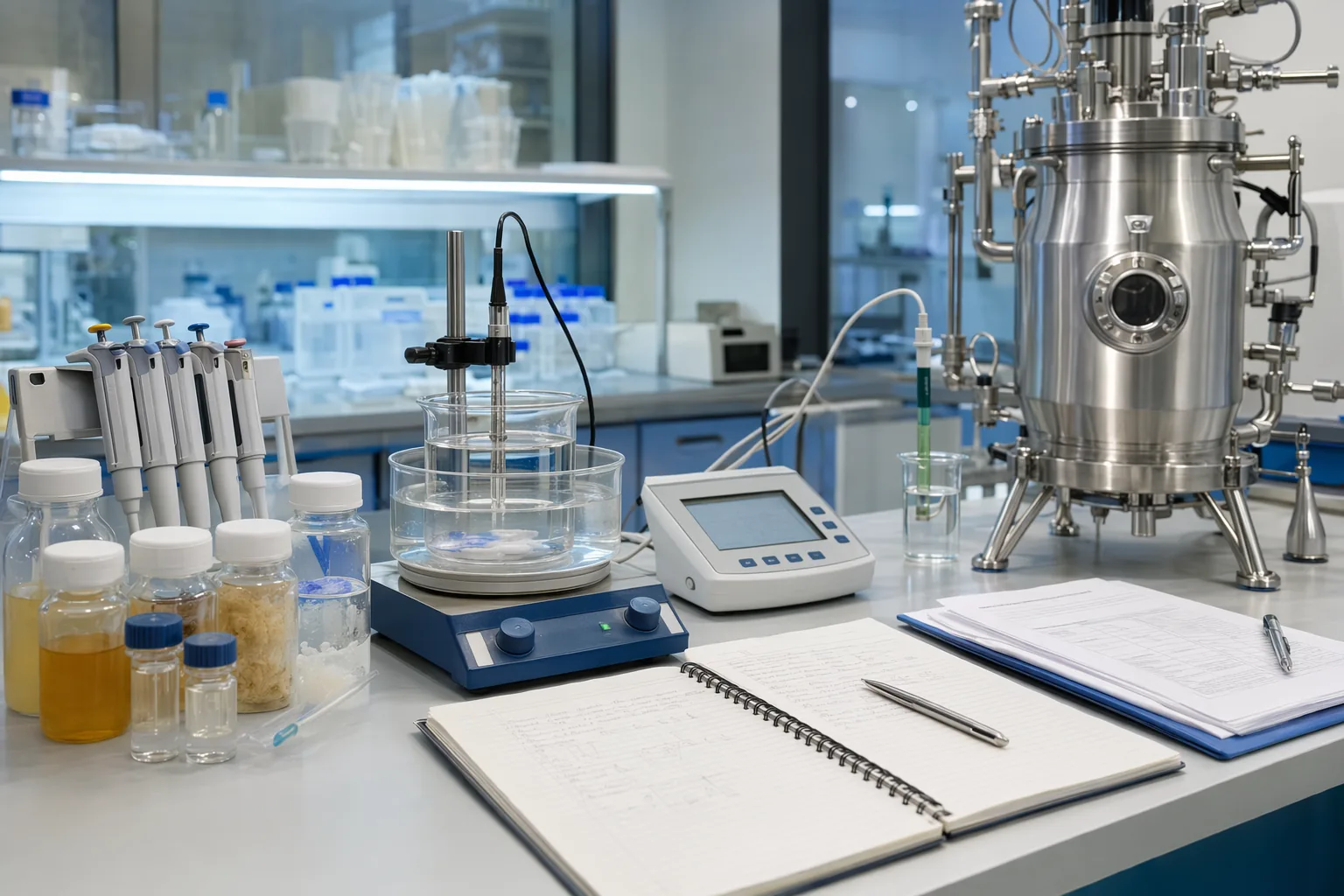
Use EnzymeCollect to evaluate small quantity enzymes for R&D, bench testing, and pilot scale validation before committing to production supply.
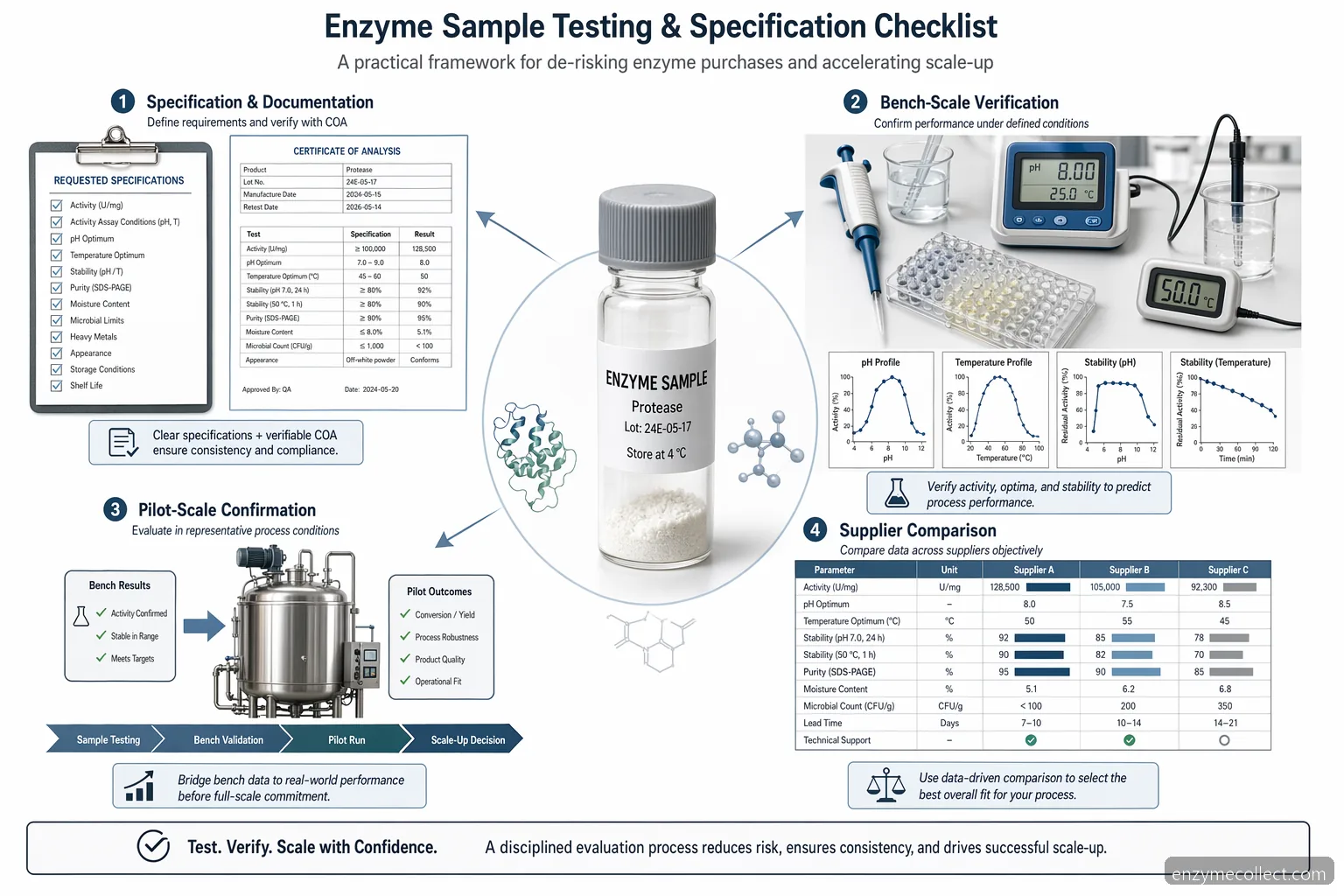
Why Sample Testing Matters Before Enzyme Purchasing
Industrial enzyme samples testing helps procurement, R&D, and process engineering teams compare activity, compatibility, and economics before placing a larger order. A data sheet may show typical activity, but performance depends on your substrate, water chemistry, pH, temperature profile, residence time, inhibitors, and downstream processing limits. For this reason, enzyme samples for testing should be evaluated against a written protocol rather than by visual observation alone. EnzymeCollect supports buyers seeking small quantity enzymes for R&D, testing, and pilot scale work, where the goal is to reduce technical risk before supplier approval. A structured comparison also prevents over-ordering and helps teams identify whether an enzyme delivers measurable value at a practical dose. For industrial enzyme trial order testing, the best result is not simply maximum activity; it is stable, repeatable performance at a cost-in-use that fits the process.
Compare candidates under identical process conditions. • Record both performance and handling observations. • Use pilot data before scaling to routine supply.
Define the Target Application and Test Conditions
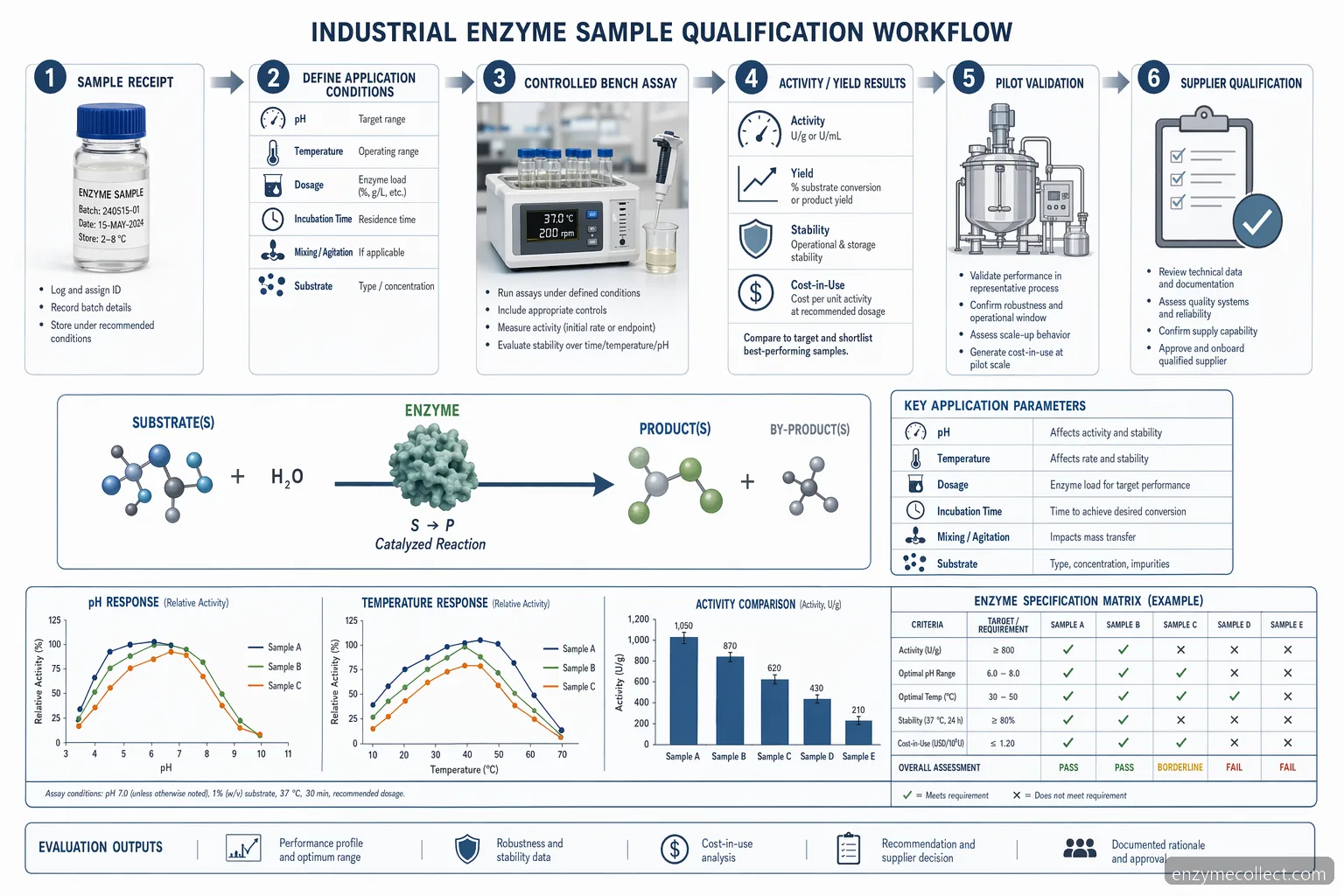
Before requesting industrial enzyme samples for testing, define the operating window clearly. State the substrate, solids level, batch size, expected contact time, and any cleaning, neutralization, or heating step that may affect activity. Typical screening may examine pH 4.0-6.5 for many carbohydrase applications, pH 6.0-8.5 for neutral systems, or pH 8.0-10.5 where alkaline compatibility is required. Temperature ranges often include 30-60°C for mild processing and 60-85°C for thermostability screening, depending on the enzyme class and substrate tolerance. Dosage bands may be tested from 0.01-0.50% w/w of substrate or as activity units per kilogram of raw material. The key is to make conditions realistic, safe, and measurable. Industrial enzyme testing R&D teams should include untreated controls, duplicate or triplicate runs, and a defined endpoint such as viscosity reduction, yield increase, hydrolysis degree, cleaning performance, or reaction time reduction.
Document pH, temperature, time, substrate load, and agitation. • Use controls and repeat runs to confirm trends. • Avoid comparing enzymes at different dosages without normalization.
Documentation to Request with Every Sample
A reliable enzyme samples supplier for testing should provide documentation before shipment or immediately with the sample. The Certificate of Analysis should identify batch number, declared activity or assay basis, appearance, and relevant quality checks. The Technical Data Sheet should describe recommended pH and temperature ranges, application guidance, storage conditions, shelf life, and handling notes. The Safety Data Sheet should support workplace risk review, including PPE, inhalation precautions for powders, spill response, and transport information. For industrial enzyme testing testing programs, documentation quality is part of supplier qualification because it shows whether the supplier can support repeat purchasing and audit readiness. Buyers should avoid relying only on verbal activity claims. If the enzyme is intended for a regulated or sensitive manufacturing environment, confirm whether additional statements, allergen information, or origin details are available without assuming unsupported certifications.
COA: batch, activity, QC results, release date. • TDS: application range, dosage, storage, shelf life. • SDS: hazard communication and safe handling guidance.
Bench Test Design for Comparable Results
A strong bench protocol makes industrial enzyme samples R&D comparisons easier to defend. Start with a small matrix that includes a control, a low dose, a target dose, and a high dose for each candidate. For example, test 0.05%, 0.10%, and 0.25% w/w where compatible with the application, or use equivalent activity units when comparing products with different concentrations. Keep pH, temperature, mixing speed, sample mass, and reaction time constant. Measure the response with an objective method such as reducing sugar formation, viscosity, filtration rate, stain removal, protein hydrolysis, particle size change, or yield. Include checks for off-odor, color impact, foam, sediment, corrosion concern, or compatibility with preservatives and process aids. Record enzyme lot numbers and storage time. This approach helps buyers distinguish real performance differences from noise caused by inconsistent preparation, substrate variation, or operator handling.
Use an untreated control for every test set. • Normalize dosage by activity when possible. • Track handling, solubility, odor, foam, and residue.
Pilot Scale Validation and Cost-in-Use
Industrial enzyme samples pilot scale trials should confirm that bench results translate to actual equipment. Pilot validation may reveal limitations caused by heat-up time, dead zones, pumping shear, substrate variability, dosing accuracy, or hold-time changes. Use a practical trial batch that reflects the intended process, then compare yield, cycle time, energy input, wastewater load, cleaning demand, or product quality against the standard process. Cost-in-use should include enzyme price, effective dosage, dilution or preparation labor, storage losses, reduced processing time, improved recovery, rejected batch risk, and any downstream neutralization or filtration impact. The lowest price per kilogram is not always the lowest operating cost. For industrial enzyme testing pilot scale work, request enough sample volume to complete at least one setup run and one confirmation run. Document whether the supplier can provide the same grade and activity range for future production lots.
Confirm dosing accuracy in real equipment. • Measure operational savings, not only enzyme activity. • Run at least one confirmation batch before approval.
How to Compare and Qualify Enzyme Suppliers
Supplier comparison should combine technical data, commercial terms, and service responsiveness. An industrial enzyme trial order testing program should ask each supplier for the same sample size, documentation set, recommended dosage range, storage guidance, and lead time. Evaluate whether responses are specific to your application or generic. Ask how activity is measured, what batch-to-batch variation is typical, and whether retained samples are available for investigation if performance changes. Also review minimum order quantity, packaging options, sample replenishment, temperature control during shipping, and support for scale-up troubleshooting. A qualified supplier does not need to promise universal performance; they should help you design a realistic evaluation and provide consistent information. EnzymeCollect is positioned for buyers comparing enzyme samples, enzyme testing options, and small quantity enzymes where a practical, documented pathway from sample to pilot order is required.
Compare documentation completeness and response quality. • Review MOQ, lead time, packaging, and storage needs. • Ask how batch consistency is monitored.
Technical Buying Checklist
Buyer Questions
Request enough sample for a control comparison, at least three dosage levels, repeat testing, and one pilot confirmation if feasible. The required amount depends on substrate load, dosage, and batch size. For early R&D, small quantity enzymes may be sufficient, but pilot scale validation usually requires more material to confirm dosing, handling, and performance in representative equipment.
Ask for a Certificate of Analysis, Technical Data Sheet, and Safety Data Sheet for each sample lot. The COA supports batch identity and quality review, the TDS provides application and storage guidance, and the SDS supports workplace handling decisions. These documents also help procurement compare suppliers beyond price and create traceable records for later qualification.
Use the same substrate, pH, temperature, mixing, reaction time, and measurement method for each candidate. Include untreated controls and normalize dosage by activity units if the supplied concentrations differ. Run duplicates or triplicates where possible. A fair comparison should measure a defined process result, not only appearance or supplier-stated activity.
Bench tests reduce risk, but pilot trials show whether the enzyme works in real equipment. Scale-up can change heat transfer, mixing, hold time, dosing accuracy, and exposure to inhibitors. Pilot validation also helps calculate cost-in-use, including enzyme dose, cycle time, yield impact, waste reduction, and downstream processing effects before routine purchasing.
Enzyme price is the purchase cost per kilogram or liter. Cost-in-use reflects the total operating effect at the required dose. It may include dosage efficiency, yield improvement, shorter processing time, lower energy use, reduced rejects, extra dilution labor, storage loss, or filtration changes. The best enzyme is often the one with the strongest validated economics.
Alpha-Galactosidase for Research & Industry
Need Alpha-Galactosidase for your lab or production process?
ISO 9001 certified · Food-grade & research-grade · Ships to 80+ countries
Frequently Asked Questions
How much enzyme sample should we request for testing?
Request enough sample for a control comparison, at least three dosage levels, repeat testing, and one pilot confirmation if feasible. The required amount depends on substrate load, dosage, and batch size. For early R&D, small quantity enzymes may be sufficient, but pilot scale validation usually requires more material to confirm dosing, handling, and performance in representative equipment.
What documents should come with industrial enzyme samples?
Ask for a Certificate of Analysis, Technical Data Sheet, and Safety Data Sheet for each sample lot. The COA supports batch identity and quality review, the TDS provides application and storage guidance, and the SDS supports workplace handling decisions. These documents also help procurement compare suppliers beyond price and create traceable records for later qualification.
How should we compare two enzyme samples fairly?
Use the same substrate, pH, temperature, mixing, reaction time, and measurement method for each candidate. Include untreated controls and normalize dosage by activity units if the supplied concentrations differ. Run duplicates or triplicates where possible. A fair comparison should measure a defined process result, not only appearance or supplier-stated activity.
Why is pilot validation needed after successful bench testing?
Bench tests reduce risk, but pilot trials show whether the enzyme works in real equipment. Scale-up can change heat transfer, mixing, hold time, dosing accuracy, and exposure to inhibitors. Pilot validation also helps calculate cost-in-use, including enzyme dose, cycle time, yield impact, waste reduction, and downstream processing effects before routine purchasing.
What is the difference between enzyme price and cost-in-use?
Enzyme price is the purchase cost per kilogram or liter. Cost-in-use reflects the total operating effect at the required dose. It may include dosage efficiency, yield improvement, shorter processing time, lower energy use, reduced rejects, extra dilution labor, storage loss, or filtration changes. The best enzyme is often the one with the strongest validated economics.
Ready to source?
Turn This Guide Into a Supplier Brief Request enzyme samples and testing support for your R&D or pilot evaluation.
Contact Us to Contribute